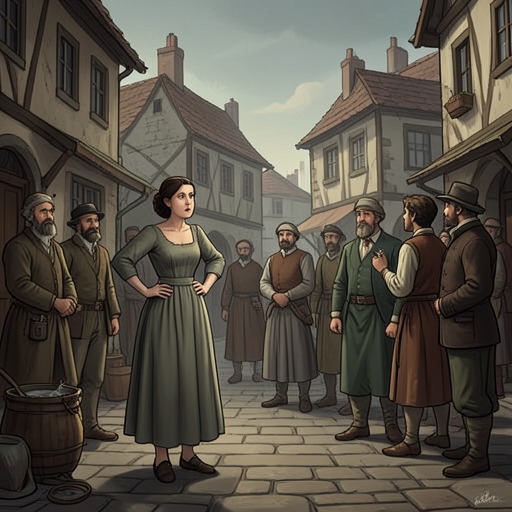
Caroline
The Murder of Roger AckroydCaroline, the sister of Dr. James Sheppard, is King’s Abbot’s most tireless intelligence-gatherer: she turns ordinary village life into a web of reports, suspicions, and disclosures. Her curiosity supplies comic energy, but it also has consequences for the investigation, helping transmit information that puts Ralph Paton under suspicion and later guiding Poirot toward the place where Ralph is concealed.
Identity and Place in King’s Abbot
Caroline’s defining pursuit is finding out what other people know and what they have not yet said. When James returns home, he pauses in the hall because he is worried that news of Mrs. Ferrars’s death will reach his sister. As a doctor, he values discretion; he expects Caroline to spread whatever he tells her across the village within an hour and a half. He therefore withholds information, though he admits that she generally discovers it anyway. The distinction gives James a measure of moral satisfaction, not practical control.
This habit belongs to the village as much as to Caroline. King’s Abbot is described as a place whose hobbies can be summed up as gossip, with its residents linked by shops, servants, and everyday exchanges. Caroline is its most vivid practitioner: James imagines her as a mongoose whose motto is to go and find out, then jokes that she can do the finding from home. When she does venture out, he says, she is more likely to spread information than gather it. The comic portrait also establishes her as a local communications hub.
Curiosity and the Limits of Her Network
Caroline’s intelligence-gathering has blind spots. She is intensely frustrated that she can learn almost nothing about the foreign stranger who has taken the neighboring house, The Larches. Her usual sources among the people supplying milk, vegetables, meat, and fish have failed her; all she knows is that the newcomer is interested in growing vegetable marrows. That fragment does not satisfy her appetite for personal detail, from a stranger’s origins and family to his marital history. Her curiosity is therefore not simply omniscience: it is an appetite tested by what the village’s ordinary channels cannot reach.
The contrast between her confidence and the gaps in her knowledge gives her role a playful edge. She is accustomed to treating information as something obtainable through persistence and social connection, yet the stranger’s privacy frustrates her. The episode shows both the reach and the limits of the network that makes her so formidable within King’s Abbot.
Involvement in the Investigation
When James learns that Inspector Davis has heard a garbled account of blackmail from Parker, he recognizes the danger of loose talk and decides to disclose what he knows. Caroline’s habits form the domestic counterpart to that investigative problem: information can travel through overheard conversation as well as deliberate questioning. Later, James sharply asks whether she told Poirot what she had overheard in the wood. Caroline confirms that she did. James warns that, by reporting it, she is putting Ralph Paton in danger of being treated as guilty. Her disclosure thus becomes more than village gossip: it enters the chain of evidence and affects the pressure on a man already under suspicion.
Caroline also provides a route to information about James himself, though she does not recognize what her knowledge may enable. In explaining how he found Ralph, Poirot says that he invented a nephew with mental troubles and asked Mademoiselle Sheppard for suitable nursing homes near Cranchester. She gave him the names of two institutions to which her brother had sent patients. Poirot made inquiries, identified Ralph among the patients at one of them, and brought him away. Caroline’s practical knowledge of her brother’s work therefore supplies the lead that defeats his concealment, even though she does not know the purpose for which Poirot is asking.
Narrative Function and Significance
Caroline’s information network forms a quiet counterpoint to James’s selective narration. He presents himself as repeatedly withholding news from her, but the plot shows that she can still pass important information to Poirot and provide him with knowledge that reaches into her brother’s professional life. Her instinct to find out, which James treats as a domestic nuisance, becomes useful to the detective; the same circulation of information can expose Ralph to suspicion and help recover him from concealment.
The character’s comic exaggeration is anchored in concrete effects. A village built around gossip gives Caroline an informal reach that neither James’s attempts at discretion nor his effort to hide Ralph can fully contain. She is not merely a source of rumors: she is one of the means by which private knowledge moves between households, the village, and the investigation.